- MQL5 73.3%
- MQL4 13.5%
- Python 13.2%
| Filename | Latest commit message | Latest commit date |
|---|---|---|
|
|
||
| docs | ||
| LICENSES | ||
| mql4 | ||
| mql5 | ||
| tests | ||
| .gitignore | ||
| LICENSE | ||
| README.md | ||
| requirements.txt | ||

Candlestick Signal Alerts (MetaTrader 5 and MetaTrader 4)
A free indicator that marks 13 classic candlestick patterns on the chart with an arrow and a short label, on closed bars only, and sends an alert when a new one completes. Source for both editions, a Python reference of the rules, and the tests that were used to check that the MT5 and MT4 code, the Python reference and each other all agree.
Website: allanninal.dev/mql5 (indicators) · MT4 editions · allanninal.dev · Contact: message me on LinkedIn.
It is an indicator, not a strategy. It draws marks and places no trades. Nothing here is a profit claim (see Honest limits).
Get it on the MQL5 Market
| Edition | Platform | Price | Link |
|---|---|---|---|
| Candlestick Signal Alerts | MT5 | free | https://www.mql5.com/en/market/product/201775 |
| Candlestick Signal Alerts MT4 | MT4 | free | https://www.mql5.com/en/market/product/202358 |
The Market builds are the same calculation as the source in this repository.
Contents
- What it is and who it is for
- Why it was built
- How it works
- Non-repainting: the proof and how it was tested
- Architecture and buffers
- Inputs, alerts, install and compile
- Run the Python reference and the tests
- Honest limits
- Licence
What it is and who it is for
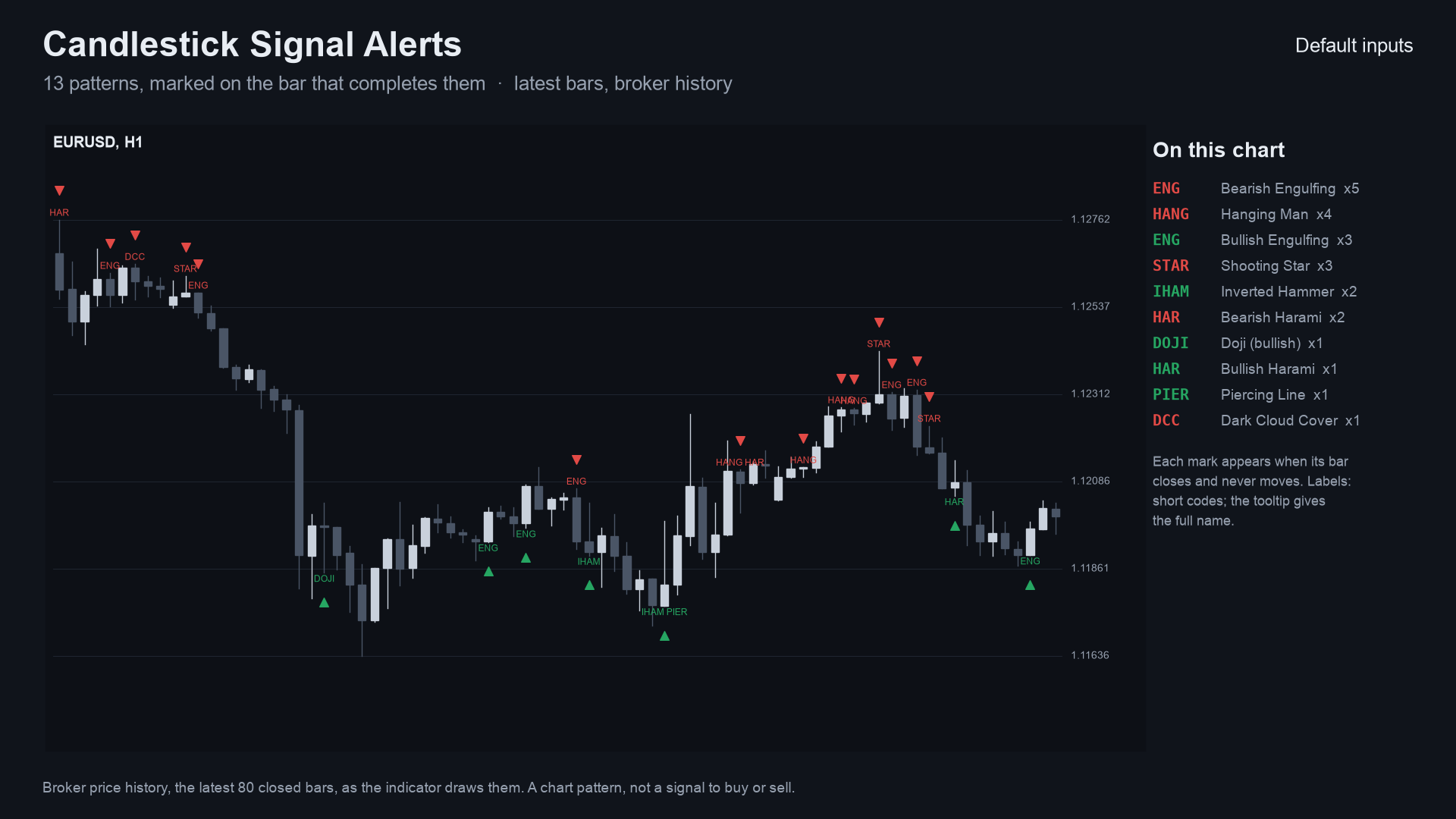
What: 13 textbook candlestick patterns found by fixed numeric rules. Each pattern gets an arrow (green up for a
bullish pattern, red down for a bearish one) and a short label (ENG, HAM, HANG, IHAM, STAR, DOJI, MSTAR,
ESTAR, HAR, PIER, DCC) on the bar that completes it. Point at a label to read the full name. Alerts: pop-up
(on by default), sound, push notification, e-mail.
For: traders who read candles and want the patterns found for them, with a definition they can read. Also for
developers who want a small, tested pattern engine with documented buffers to read from an EA with iCustom.
Not for: anyone who expects a pattern to predict direction. A pattern describes the shape of one to three bars.
 |
 |
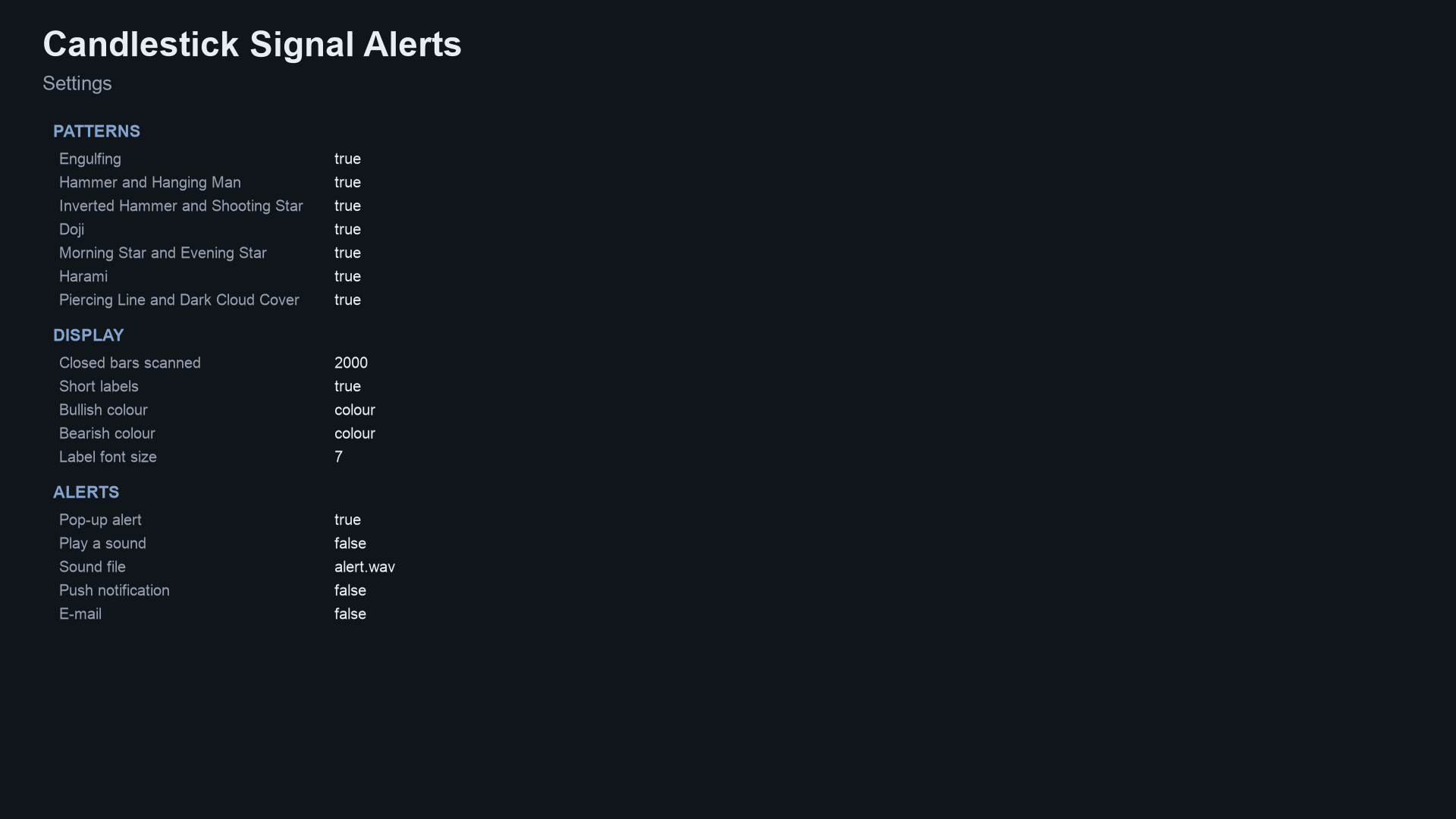 |
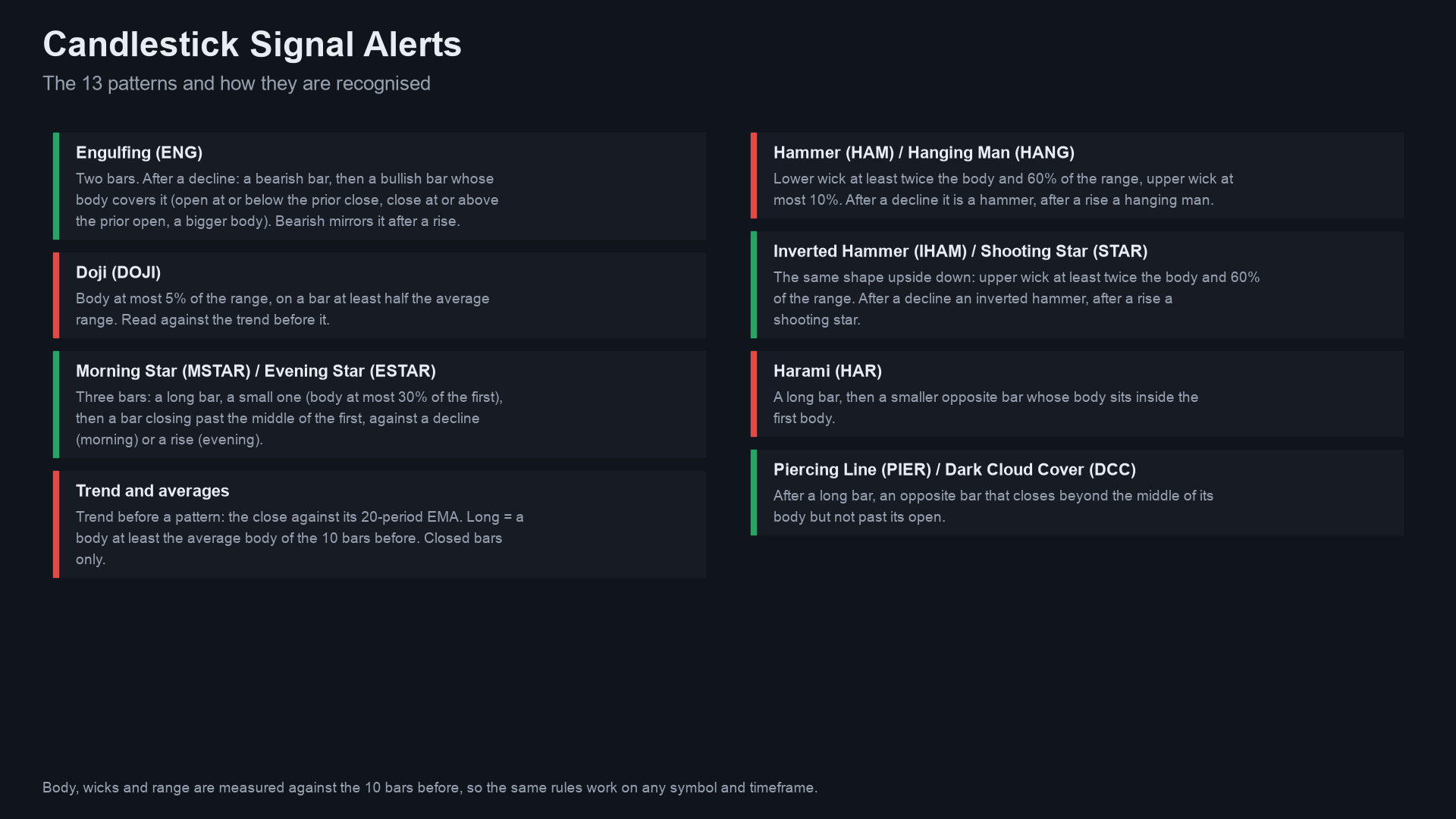
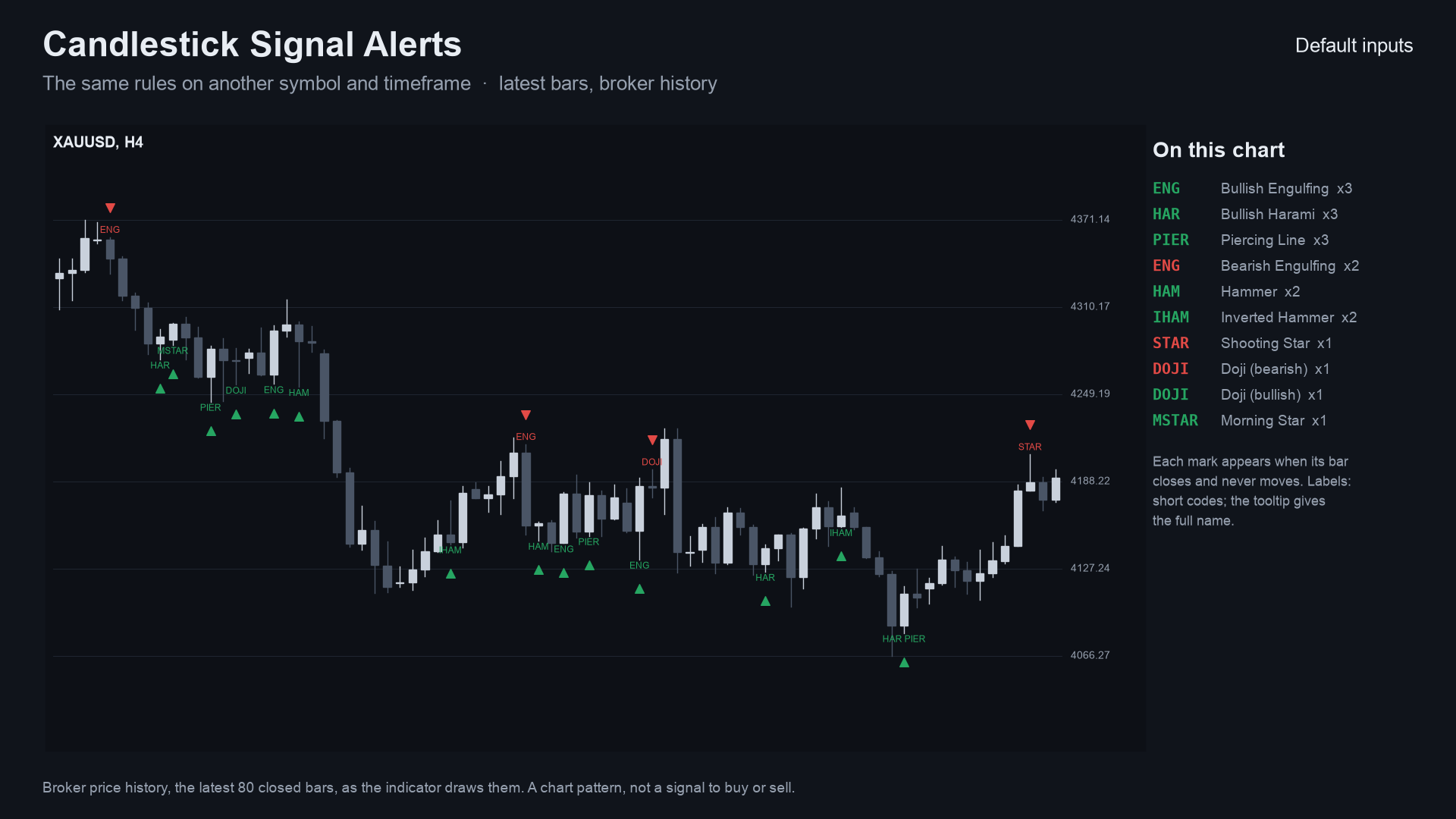
Image notes: the charts are drawn by the Python reference on broker price history (the same marks the indicator shows);
the rules and settings sheets are illustrations, not terminal captures. MT4 versions are in
docs/images/mt4/.
Why it was built
Candlestick patterns are the most-read chart method there is, and the market for them is crowded. The motivations, stated with the evidence we actually have:
- A readable definition. Many pattern indicators are closed boxes whose rules cannot be checked. Here every rule is a
line of arithmetic in
tests/reference.pyand in the.mqhengine. - Trust in the marks. A mark is only drawn on a bar that has closed and never moves afterwards. Our market research (demand scan of MQL5 Market, forums, freelance boards and book and course audiences, October 2026) found repeated complaints about indicators that repaint.
- Honest scale of demand. The same research counted roughly 170 candlestick-pattern indicators on the MQL5 Market (about 54 of them free) and the largest dedicated reading audience of any method, but concluded that patterns alone are a crowded, low-differentiation product. This is a free tool with a clean, tested reference implementation, not a claim of unmet demand.
- Provable behaviour. Every number in this README comes from an executed check, listed below.
mindmap
  root((Candlestick Signal Alerts))
    Problem
      Pattern indicators with hidden rules
      Marks that move or vanish after the bar closes
      Alerts that fire twice or during history load
    Design rules
      13 patterns, each a few lines of arithmetic
      Marks on closed bars only
      One alert per bar
      Same rules on MT5 MT4 and Python
    Proof
      Python reference
      Bar by bar parity
      Tester repaint probe
      Market validation
How it works
The measures, step by step
Let O, H, L, C be a bar's open, high, low, close and k the bar being decided (the bar that just closed). Bars are
numbered oldest first.
| Measure | Formula |
|---|---|
| body | ` |
| range | H - L |
| upper wick | H - max(O, C) |
| lower wick | min(O, C) - L |
| average body, average range | simple average of the body / range of the 10 bars before k (k-10 ... k-1) |
trend at bar j |
+1 if C[j] > EMA20[j], -1 if below, 0 otherwise. EMA20 is seeded with the average of the first 20 closes, then EMA[i] = EMA[i-1] + 2/21 * (C[i] - EMA[i-1]) |
| tie tolerance | comparisons treat values within 1e-9 x price as equal (see the tie lesson) |
A bar is bullish if C > O, bearish if C < O. Nothing is decided before bar 10 (the averages) or bar 3.
The 13 patterns
b = body of k, r = range of k, u / w = upper / lower wick of k, p = k-1, q = k-2, ab = average body,
ar = average range, t1, t2, t3 = trend at k-1, k-2, k-3.
| # | Pattern | Direction | Rule (all conditions) |
|---|---|---|---|
| 0 | Bullish Engulfing | + | p bearish, k bullish, O[k] <= C[p], C[k] >= O[p], b > body[p], t2 < 0 |
| 1 | Bearish Engulfing | - | mirror: p bullish, k bearish, O[k] >= C[p], C[k] <= O[p], b > body[p], t2 > 0 |
| 2 | Hammer | + | w >= 2b, u <= 0.1r, w >= 0.6r, r > 0, t1 < 0 |
| 3 | Hanging Man | - | the same shape, t1 > 0 |
| 4 | Inverted Hammer | + | u >= 2b, w <= 0.1r, u >= 0.6r, r > 0, t1 < 0 |
| 5 | Shooting Star | - | the same shape, t1 > 0 |
| 6 | Doji | -t1 |
b <= 0.05r, r >= 0.5 ar, r > 0, t1 != 0 (direction is against the trend before it) |
| 7 | Morning Star | + | q bearish with body[q] >= ab; body[p] <= 0.3 body[q]; min(O[p], C[p]) <= C[q]; k bullish and C[k] > (O[q]+C[q])/2; t3 < 0 |
| 8 | Evening Star | - | mirror: q bullish, max(O[p], C[p]) >= C[q], k bearish, C[k] < (O[q]+C[q])/2, t3 > 0 |
| 9 | Bullish Harami | + | p bearish with body[p] >= ab, k bullish, O[k] >= C[p], C[k] <= O[p], b < body[p], t2 < 0 |
| 10 | Bearish Harami | - | mirror: p bullish, k bearish, O[k] <= C[p], C[k] >= O[p], b < body[p], t2 > 0 |
| 11 | Piercing Line | + | p bearish with body[p] >= ab, k bullish, O[k] <= C[p], (O[p]+C[p])/2 < C[k] < O[p], t2 < 0 |
| 12 | Dark Cloud Cover | - | mirror: p bullish, k bearish, O[k] >= C[p], O[p] < C[k] < (O[p]+C[p])/2, t2 > 0 |
The inputs group the 13 into seven switches (engulfing, hammer and hanging man, inverted hammer and shooting star, doji, stars, harami, piercing and dark cloud). Several patterns can complete on the same bar; the label then lists each.
Per-bar algorithm
flowchart TD
    A[New or updated bar] --> B{Is it a closed bar?}
    B -- no, the forming bar --> Z[Nothing drawn, no alert]
    B -- yes --> C[Feed O H L C to the engine]
    C --> D[Update EMA20, keep the last bars]
    D --> E{At least 10 bars of history?}
    E -- no --> Z
    E -- yes --> F[Body, range, wicks, 10-bar averages, trend]
    F --> G[Test the 13 rules, each switched on or off]
    G --> H{Any pattern complete?}
    H -- no --> Z
    H -- yes --> I[Arrow at the low if bullish, at the high if bearish, plus label]
    I --> J{Is it the bar that just closed, after the history load?}
    J -- no --> Z
    J -- yes --> K[One alert for the bar]
Signal states
stateDiagram-v2
    [*] --> Forming: bar opens
    Forming --> Forming: ticks arrive, nothing is evaluated
    Forming --> Closed: bar closes
    Closed --> Scanned: engine fed once, in order
    Scanned --> Marked: at least one pattern completes
    Scanned --> Plain: no pattern
    Marked --> Alerted: latest closed bar, not history load, not the tester
    Marked --> Marked: older bar, mark stays, no alert
    Alerted --> Marked: the mark never moves or disappears
    Plain --> [*]
Alert flow
sequenceDiagram
    participant T as Terminal
    participant I as Candlestick indicator
    participant E as Engine (Cdl.mqh)
    participant U as You
    T->>I: OnCalculate (history load, prev_calculated = 0)
    I->>E: feed the last InpHistory closed bars
    E-->>I: pattern masks per bar (marks drawn, no alert)
    T->>I: OnCalculate (new bar closes, prev_calculated > 0)
    I->>E: feed the one bar that just closed
    E-->>I: mask for that bar
    alt pattern and bar time is newer than the last alert and not in the tester
        I->>U: pop-up (optional sound, push, e-mail)
    else nothing completed, same bar again or tester run
        I-->>T: nothing sent
    end
How often patterns appear (measured)
Pattern marks per 1,000 closed H1 bars, default inputs, on broker history of EURUSD, GBPJPY, XAUUSD and BTCUSD (375,988
bars in total, up to 100,000 per symbol). The engine's default InpHistory is 2,000 bars; this count scans every bar
with the Python reference. It counts marks only. It says nothing about what price does afterwards. Source:
docs/data/pattern-frequency.json, made by tests/frequency.py.
xychart-beta
    title "H1 marks per 1,000 bars, by pattern (4 symbols)"
    x-axis ["B Eng", "S Eng", "Ham", "Hang", "IHam", "Star", "Doji", "MStar", "EStar", "B Har", "S Har", "Pier", "DCC"]
    y-axis "marks per 1,000 bars" 0 --> 50
    bar [38.6, 39.9, 16.1, 15.8, 12.4, 15.0, 43.6, 5.6, 5.9, 23.8, 26.6, 8.8, 8.7]
All 13 together: 260.7 marks per 1,000 bars, so roughly one closed bar in four carries a mark. Common patterns (doji, engulfing) appear often; the three-bar stars are rare. This is why the arrows are best used as context, not as entries.
The tie lesson
Rule thresholds sit on derived values (2 x body, 0.05 x range, a midpoint). On five-digit prices, exact decimal ties
happen, for example a wick that is exactly twice the body. MT5 and Python rounded those ties differently and disagreed
on 73 bars until both engines were changed to compare with a tolerance of 1e-9 x price. The same tolerance is in
Cdl.mqh (GE, LE, GT, LT) and in tests/reference.py. Any ratio-threshold engine needs it.
Non-repainting: the proof and how it was tested
"Non-repainting" is easy to claim. Here is what was actually run. Raw result files are in tests/results/.
1. Implementations compared bar by bar. The Python reference (tests/reference.py) holds the rules; it was written first and the MQL engines were compared with it. The MT5 and MT4 indicators were dumped bar by bar (every buffer) in the MetaTrader Strategy Tester (MT4) or by a script (MT5), and tests/check_parity.py compared each dump with the reference: pattern marks must be identical on every closed bar.
Run on this exact code: compile 0 errors, 0 warnings (both editions); MT5 24 dumps and MT4 25 dumps (EURUSD, GBPJPY, XAUUSD, BTCUSD on M15, H1 and H4 with the repository's input sets; MT4 adds an every-tick run on EURUSD H1), all identical to the reference on every closed bar; the repaint probes found 0 closed bars that changed afterwards.
The wider matrix, made with the Market builds before this repository was cut from them (the same calculation; four symbols EURUSD, GBPJPY, XAUUSD, BTCUSD, M15, H1 and H4, the repository's input sets), checked here against the same reference:
| MT5 | MT4 | |
|---|---|---|
| dumps compared | 24 | 25 |
| bars compared | 1,059,555 | 624,737 |
| failures | 0 | 0 |
| result | ALL PASS | ALL PASS |
Sources: tests/results/parity-wide-run-mt5.txt, tests/results/parity-wide-run-mt4.txt. MT5 history starts later than MT4's test history on some pairs, which is why the bar counts differ.
2. Repaint probe. An EA records which signal buffers are set on each bar at the moment it closes, then reads the same bars again at the end and counts any value that changed. It also counts any signal ever shown on the still-forming bar.
| Run | Closed bars checked | Signals seen at close | Changed afterwards | Signals on the live bar |
|---|---|---|---|---|
| MT5, Market build, EURUSD H1, every tick, 10,411,052 ticks | 4,644 | 1,114 | 0 | 0 |
| MT4, Market build, 25 runs combined | 506,172 | 114,492 | 0 | 0 |
Source: tests/results/repaint-summary.md. The MT5 probe was run once per build on one symbol and timeframe; the MT4 probe ran on every dump run.
3. Market validation. Both Market builds passed the MQL5 Market's automated product validation before publication (this is the Market's own check, not part of this repository).
flowchart LR
    R[reference.py<br/>Python rules] --> P
    S5[MT5 indicator] --> T5[Tester script<br/>DumpIndicator<br/>every bar to CSV]
    S4[MT4 indicator] --> T4[Tester EA<br/>Dump4.mqh<br/>CSV + repaint log]
    T5 --> P[check_parity.py<br/>identical on every closed bar]
    T4 --> P
    S5 --> RP[RepaintProbe EA<br/>values at close vs final]
    T4 --> RL[repaint log<br/>per run]
    P --> V{all pass?}
    RP --> V
    RL --> V
    V -- yes --> M[Market validation]
    V -- no --> F[fix, rerun everything]
Why the design cannot repaint
- The engine is fed only bars up to
rates_total - 2, i.e. never the forming bar, so a mark is created only after its bar has closed. - Each decision uses that bar and earlier bars only (no look-ahead): the pattern's own bars, the 10 bars before, and the EMA, which is a recursive formula.
- Alerts fire only for the bar that just closed, only after the history load, once per bar, and never in the tester.
Architecture and buffers
flowchart TB
    subgraph MT5["mql5/Indicators/CandlestickSignalAlerts"]
        A5[CandlestickSignalAlerts.mq5<br/>inputs, buffers, labels, OnCalculate]
        E5[Cdl.mqh<br/>13 rules, EMA20, tie tolerance]
        B5[SignalAlerts.mqh<br/>alert inputs, SignalAlertMessage]
        A5 -- include --> E5
        A5 -- include --> B5
    end
    subgraph MT4["mql4/Indicators/CandlestickSignalAlerts"]
        A4[CandlestickSignalAlerts.mq4]
        E4[Cdl.mqh<br/>identical to the MT5 file]
        B4[SignalAlerts.mqh<br/>MT4 edition]
        A4 -- include --> E4
        A4 -- include --> B4
    end
    subgraph TESTS[tests]
        R[reference.py]
        C[check_parity.py]
        D5[mql5: DumpIndicator, RepaintProbe, Params.mqh]
        D4[mql4: CandlesDump.mq4, Dump4.mqh]
        C --> R
    end
    D5 -. IndicatorCreate .-> A5
    D4 -. iCustom .-> A4
classDiagram
    class CandlestickSignalAlerts {
        +InpEngulfing bool
        +InpHammer bool
        +InpInverted bool
        +InpDoji bool
        +InpStars bool
        +InpHarami bool
        +InpPiercing bool
        +InpHistory int
        +OnInit()
        +OnCalculate()
    }
    class CDState {
        +cnt int
        +ev_mask int
        +ev_dir int[13]
        +o h l c double[16]
        +ema double[16]
    }
    class Engine {
        +CDInit()
        +CDFeed()
        +CDNames()
        +CDName()
        +CDShort()
    }
    class SignalAlerts {
        +InpAlertPopup bool
        +InpAlertSound bool
        +InpAlertPush bool
        +InpAlertEmail bool
        +SignalAlertMessage()
    }
    class reference {
        +run()
    }
    CandlestickSignalAlerts --> Engine : feeds closed bars
    Engine --> CDState : ring of 16 bars
    CandlestickSignalAlerts --> SignalAlerts : alerts
    reference ..> Engine : same rules, compared by check_parity
iCustom buffer table (for EA developers)
| Buffer | MT5 | MT4 |
|---|---|---|
| 0 | Bullish arrow price (bar low on MT5, below it on MT4), empty otherwise | same |
| 1 | Bearish arrow price (bar high on MT5, above it on MT4), empty otherwise | same |
| 2 | bit mask of the bullish patterns on the bar (bit n = pattern n of the table above) |
same |
| 3 | bit mask of the bearish patterns on the bar | same |
Empty value is EMPTY_VALUE. Read marks on closed bars (shift 1 and higher). The InpHistory setting limits how far
back marks are drawn. iCustom parameters follow the input order: seven pattern switches, history, labels, bullish
colour, bearish colour, font size, (MT4 only: arrow gap), pop-up, sound, sound file, push, e-mail, debug. In MT5 the input group
headings also count as string parameters when you build a handle with IndicatorCreate (see
tests/mql5/Include/IndTest/Params.mqh and the strings in tests/check_parity.py).
Inputs, alerts, install and compile
| Input | Default | Meaning |
|---|---|---|
| Engulfing, Hammer and Hanging Man, Inverted Hammer and Shooting Star, Doji, Morning/Evening Star, Harami, Piercing and Dark Cloud | all on | Switch a group of patterns on or off |
| Closed bars to scan on the chart | 2000 (100-20000) | How far back marks are drawn |
| Short labels | true | Show the label text next to each arrow |
| Bullish colour, Bearish colour, Label font size | green, red, 7 | Look only |
| Arrow distance from the candle (MT4 only) | 0.5 x ATR(14) | MT4 cannot shift arrows by pixels |
| Pop-up alert | true | Terminal alert window |
| Play a sound / sound file | false / alert.wav | File from the terminal's Sounds folder |
| Push notification | false | Needs your MetaQuotes ID in Options |
| false | Needs e-mail set up in Options | |
| Debug log for bug reports | false | Writes extra lines to the Experts tab, to attach when you report a problem |
Install from source. Copy mql5/Indicators/CandlestickSignalAlerts/ into <terminal data folder>/MQL5/Indicators/ (MT5) or
mql4/Indicators/CandlestickSignalAlerts/ into <data folder>/MQL4/Indicators/ (MT4), open the .mq5 or .mq4 in
MetaEditor and press Compile (F7). Both compile with 0 errors and 0 warnings (checked on a Windows machine with MetaEditor, from a clean scratch folder that holds only these files; the compiled files are not in
the repository). Keep the three files of each edition together: the indicator includes Cdl.mqh and SignalAlerts.mqh
from its own folder. The debug log needs the Chart Kit file as well: copy mql5/Include/ChartKit/ (MT5) or mql4/Include/ChartKit/ (MT4) into the Include folder of the data folder.
Run the Python reference and the tests
python3 -m venv .venv && . .venv/bin/activate && pip install -r requirements.txt
import sys; sys.path.insert(0, "tests")
from reference import run, NAMES
# o, h, l, c are float lists of OHLC bars, oldest first
rows = run(o, h, l, c)          # rows[k]["ev"] = [(pattern index, direction), ...], rows[k]["mask"] = bit mask
To repeat the parity check on your own data:
- Compile the indicator and the test tool for your platform (
tests/mql5/Scripts/DumpIndicator, ortests/mql4/CandlesDump.mq4withtests/mql4/Include/IndTest4/Dump4.mqhin yourMQL4/Include/IndTest4/; MT5 also needstests/mql5/Include/IndTest/Params.mqh). - Run it in the Strategy Tester (MT4) or as a script (MT5) for each symbol and timeframe, with the input sets in
tests/configs.tsv(MT5; the exactInpParamsstrings are intests/check_parity.py) andtests/mql4/configs.tsv(MT4). The tool writes one CSV per symbol and timeframe into adumpfolder. python3 tests/check_parity.py <folder that contains dump>(add--mt4for MT4 dumps). It prints PASS or FAIL per file and an overall result.- Repaint: run
tests/mql5/Experts/RepaintProbein the MT5 Strategy Tester (every tick); the MT4 test EA writes its repaint log with the dump.
The price dumps used for the published numbers are not in this repository (they are broker price data).
Honest limits
- A pattern is not a strategy. No stop-loss, position sizing or exit rules are provided or implied, and the rules were not optimised or back-tested for profit. In the author's own check of how price moved after these patterns, the moves were close to what follows any bar: no edge is claimed anywhere.
- No profit or accuracy claim is made. The only numbers here are about consistency (the implementations agree, marks do not move) and frequency (marks per 1,000 bars).
- The definitions are one reading. Candlestick names have several textbook definitions. These are the thresholds above (for example a hammer's lower wick of at least twice the body); other tools differ, so counts will differ.
- The trend test is simple. "Trend before" is the close against its 20-period EMA, not a swing analysis.
- Frequent marks. About one closed bar in four carries a mark at default settings. Switch groups off to cut noise.
- Scope of the tests. Four symbols on M15, H1 and H4 for the Market builds (the same calculation), the repository's input sets, one MT5 repaint run; the code in this repository has so far been compile-checked only, and the MT5 build was not run on a live chart as part of these numbers. Other symbols and timeframes are not covered by the published numbers.
Licence
Copyright 2026 Allan Niñal (https://www.allanninal.dev/mql5). Licensed under the
PolyForm Noncommercial License 1.0.0: source-available, free for personal
and other noncommercial use, not for commercial use. Each source file has an SPDX-License-Identifier line. Text:
LICENSE. The candlestick patterns are textbook definitions; the code is original. The licence applies to this
source, not to anything you build or trade with the indicator. Trading involves risk; the software is provided as is.
Website: allanninal.dev/mql5 · MT4 · allanninal.dev · Questions: message me on LinkedIn.